Scarlatti was born into a musical family as the sixth of ten childen. His father Alessandro was a renowned
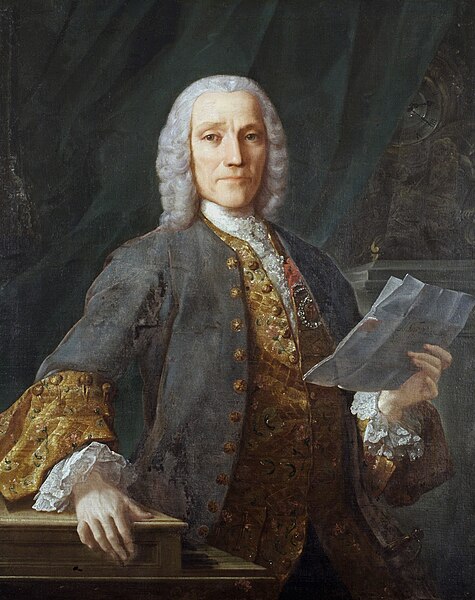
In 1701, Scarlatti was appointed composer and organist at the royal chapel in Naples where his father was maestro, and in 1704 when his father travelled to Rome, he took on his duties, amongst which were revising Carlo Francesco Pollarolo's opera Irene for performance at Naples. Shortly afterwards however, Scarlatti resigned his post and joined his father in Rome. In 1705 in an effort to secure a post for his son, Alessandro sent him to Venice. Nothing is known of Scarlatti's four years there, but in 1709 he returned to Rome, and into the service of the exiled Polish queen Marie Casimire. While in Rome, Scarlatti composed several operas for the queen's private theatre, and was Maestro Di Cappella at St. Peter's Basilica from 1715 to 1719. There is a famous legend of Scarlatti showcasing his harpsichord skills in a keyboard battle with Handel at the palace of Cardinal Ottoboni. The supposed outcome is that Scarlatti prevailed on the harpsichord, Handel on the organ.
In 1719 Scarlatti travelled to London to direct his opera Narciso at the King's Theatre. He then spent several years in Lisbon where he taught music to the Portuguese Princess Maria Magdalena Barbara. The death of his father recalled him to Naples in 1725, but he didn't remain for long. He returned to Rome in 1727, where he married Maria Caterina Gentili in 1728. The next year upon invitation from his former student Princess Maria Barbara, he moved to Seville, Spain where he stayed for four years and gained knowledge of flamenco. Afterwards he took a post in Madrid as music master to the Princess, who had married into the Spanish royal family. The princess later became Queen of Spain.
Scarlatti lived in Spain for the remaining 25 years of his life, having five children, and marrying a Spaniard Anastasia Maxarti Ximenes after his first wife's death in 1742. It was in Madrid during this time that Scarlatti composed the 555 keyboard sonatas for which he is mostly remembered. Scarlatti died in Madrid, on 23rd July 1757, at the age of 71.
Scarlatti's Music
While in Spain, Scarlatti immersed himself in the region's folk tunes and dance rhythms, with their distinctive Moorish (Arabic) and later gypsy influences. This influence fused with his thorough musical grounding brought with him from Italy to create his 555 keyboard sonatas, probably composed for the use of the unusually gifted Queen Maria Barbara. Elements of Scarlatti's unique style, developed from his folk influences, include the use of "the crux" often marked by a pause; prior to this is the main material, afterwards is a modulatory section on repetitive figurations. He also used Phrygian mode and other tonal inflections which were essentially not heard of in European art music. Much of Scarlatti's technique is suggestive of the guitar. In addition to these important sonatas, Scarlatti also composed several operas, cantatas, symphonias, and liturgical pieces. Other well known works include the Stabat Mater of 1715 and the Salve Regina of 1757, which is thought to be his last composition.
Keyboard Sonata in E, K.380
I chose to listen to this sonata because of recommendations on the internet. I realised while listening that I'd heard it before, but a long time ago. This is a very melodic and lyrical piece in binary form built around a dotted semiquaver, demisemiquaver, quaver motif. The most lyrical part is the short run of doubled notes up the scale of B major (tonic key in second section).
I found the simplicity of this piece appealing, as well as its very pleasant melodies and harmonies. After the repeat of the first section you have the second section which shortly modulates to c sharp minor, and is a variation on the main theme. This change to a minor key creates a welcome change of character and contrast. Decoration in the form of trills and upper mordents are used with frequency in this sonata, which makes for a very ornate melody line.
Keyboard Sonata in B minor, K.27
This is a much different style piece to the one in E major, this time the sonata is in a predominantly minor key, and is much quicker and more complex. Near the beginning there is an interesting part where the left hand crosses over the right in order to play high crotchets in the treble register. This is followed by a flowing semiquaver passage that continues unbroken, swapping between the hands where necessary. The left hand then revisits the treble register, anticipating the first note of the right hand while the notes continue in a quick descending pattern, e.g. - f f e d, d d c b.
This sonata, like the one looked at previously, is also in binary form. The highlight for me in the second section is definitely the bass line. After a few bars introduction based on the theme from the first section, we then have a quick semiquaver pattern in the right hand, with repeated bass notes acting as a pedal. This section also features the left hand crossing over to the right, to be played simultaneously with a note in the right hand. For many of these crossing, the two notes create a brief discord that adds interest to the passage.
Overall, the piece doesn't use a great deal of ornamentation, presumably because the texture is already so quick and busy. Like the K.380, I enjoyed this piece a lot, and they both bring something different and unexpected to the table.

No comments:
Post a Comment