The shawm was made from at least the 12th century, up until the 17th century when it was replaced by the hautbois (oboe). Unlike the oboe, comprising of three sections, it was turned from a single piece of wood. The shawm is different in many other ways from the oboe too. It has a flared trumpet-like bell rather than a bulb-shaped one, it had a pirouette - a wooden ledge beneath the reed which allowed the player to rest their lips, - and had finger holes (like a recorder) instead of metal key work. Both instruments are similar in size and use a double reed however, resulting in a similar timbre.
 The shawm was originally used for military purposes by Saracens during the crusades as a psychological weapon. It soon took off in Europe, and in the 15th century was used in European outdoor dance bands. By the 16th century the shawm had undergone considerable development, with a narrowing of the bore and a reduction in the size of the fingerholes which extended the range of the instrument. Like many other instruments, in the 16th century the practice of building instruments in a full range of sizes was applied to the shawm, but the bass versions required too much tubing, and were cumbersome. an alternative was developed, with a folding back of the bore to create an instrument called the dulcian, the forerunner to today's bassoon.
The shawn was often paired with the sackbut, a Renaissance trombone. This ensemble became the standard setup for town bands called waits in Britain, and alta capella in Europe, whose job it was to herald the start of municipal functions and signal the major times of day.
Instruments resembling the shawm can still be found around the world today, played by street musicians or military bands.
Sackbut
The sackbut is an early trombone instrument. In terms of construction it is very similar to the modern trombone, except it has a smaller bore, smaller mouthpiece and smaller bell flare. The instrument also had a more delicate construction resulting in a softer sound than modern instruments.
The sackbut was developed from the early trumpet, which started life as a long straight tube with a flared bell. The trumpet gradually evolved from around 1375, and the earliest clear evidence of a double slide trombone-like instrument is in Filippino Lippi's fresco The Assumption of the Virgin from the end of the 15th century. Between the 15th and 19th centuries there was very little development, but since then the bore

Sound is produced on the sackbut by the player pressing their buzzing lips against the mouthpiece while expelling air. By altering lip pressure, five or six tones can be produced without moving the slide. When the slide is moved, it alters the length of the tubing, thus creating a new range of five to six pitches. This instrument was part of the alta capella ensemble playing courtly dance music, along with the shawm looked at above. It would also be used with cornetts or shawms in church as instrumental music, or to accompany vocal music. There was more chamber and vocal repertoire written for the instrument than any of its contemporaries of the time. In the 17th century, there was composed a significant amount of chamber music for the instrument combined with violins, cornetts and dulcians, often with basso continuo. In comparison, the late baroque and classical eras saw some, but very little repertoire produced for the instrument.
Viol
The viol family of instruments superficially look like today's string section of the orchestra, but there are many significant differences. The shape of the viol instruments are slightly different, with flat rather than curved backs, sloped rather than squared shoulders, and c holes rather than f holes. Importantly, the viol instruments also had 6 strings rather than 4, and were tuned, like a lute, in fourths with a third in the middle not in fifths. The viol also had frets on the fingerboard, and the bow was held with an underhand rather than overhand grip.
Like lutes, the viol was often played by amateurs. Wealthy families would often have one or more viol of

The bass viol continued to be used into the 18th century as both a solo instrument, and to be played with the harpsichord for bass continuo. It was gradually superseded by the violin family of instruments, which had a more piercing tone which was suited to the larger concert halls being developed.
Lute
The lute was the most important instrument for secular music in the Renaissance but was used frequently from the medieval to the baroque eras. It was used as a solo instrument, to accompany vocal works, and to realise basso continuo.
Although the lute roughly resembles a modern day acoustic guitar, there are many notable differences. The
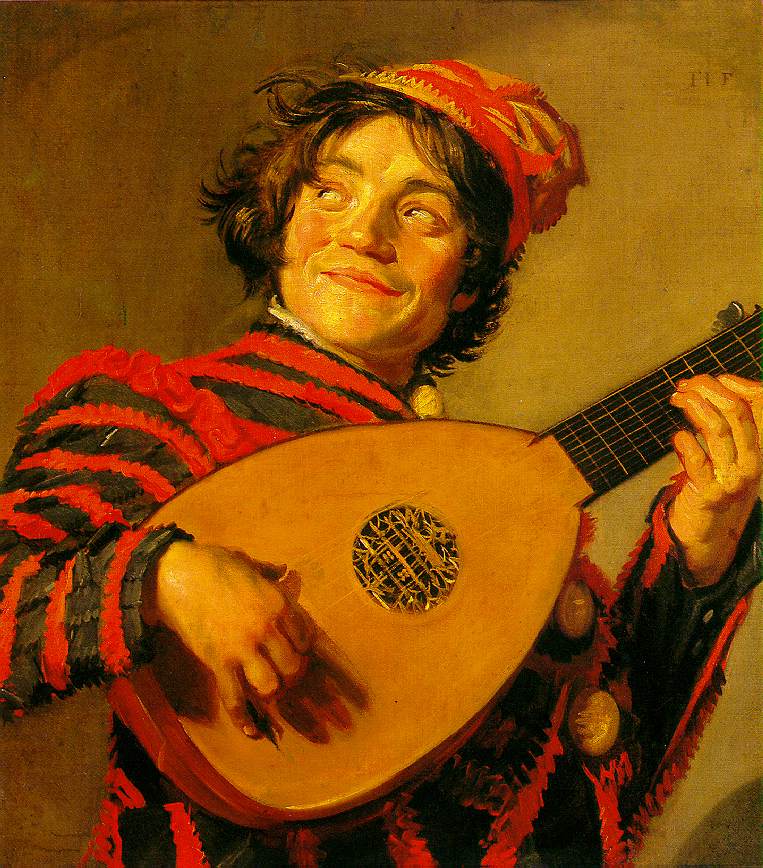
There were several sizes of lutes, with seven documented by the end of the renaissance era. Medieval lutes were 4-or 5-course instruments (a course being multiple strings tuned an octave apart, designed to be played as a single string), plucked using a quill as a plectrum. Medieval and early renaissance lute music was probably improvised, and as such very little music from before 1500 survives. It's main role at this time though was probably song accompaniment. Towards the end of the 15th century, the quill was gradually dropped in favour of plucking with the fingertips in order to play renaissance polyphony. The lute was the dominant solo instrument of the 16th century, but song accompaniment also continued.
During the baroque era although the lute continued to be developed, with the number of courses, and thus strings, ever expanding, it was gradually relegated to a basso continuo role, and fell out of use after 1800.
Crumhorn
The crumhorn is a woodwind instrument, mostly commonly used in the renaissance era. Its name means 'curved horn' in reference to its distinctive shape. It is thought that this curved shape may have been used to direct the sound back towards the player to improve intonation during group playing. The crumhorn uses a

Crumhorns have a limited range of around an octave, and as such were usually played in groups of different sized crumhorns, called 'consorts'; as for many other instruments in the renaissance, instruments were constructed in different sizes, often imitating the range of the vocal quartet, with soprano, alto, tenor and bass versions.
The pitch played by the crumhorn is governed not only by the fingerholes, but also by air pressure, which means the instrument has to be played at a fixed dynamic. The instrument was more popular in mainland Europe than in Britain. It was mostly played by professional musicians at courts and in the larger town bands.
Dulcian
The dulcian is a renaissance woodwind instrument, and has a double reed like the shawm and crumhorn, but the reed is exposed, more akin to the shawm (although it's own reed was partially enclosed) than the crumhorn. It was the predecessor to today's bassoon.
The dulcian is constructed from a single piece of wood, usually maple, and the reed is attached to a curve metal pipe called the 'bocal', which itself attaches to the instrument body. The dulcian, unlike the bassoon usually had a flared bell. The bell could be muted, with the mute being either detachable, or built into the

As the reed is fully exposed, the player can change the sound and intonation using his embouchure (shape of mouth and face muscles). It is a versatile instrument, suited to both indoor and outdoor playing, and expressive enough to join in with choirs. It was used along with shawms and sackbuts in town alta capella ensembles, in chamber music, and in the polychoral repertoire from Venice and Germany, such as Giovanni Gabrieli and Heinrich Schütz. There are also parts written for the dulcian in the sonatas by Dario Castello.
Clavichord
The clavichord was a very popular keyboard instrument, used from the late medieval all the way through to the classical era. It was rectangular in shape, and often highly decorated. The strings run horizontally, rather than vertically like a harpsichord. The range started at around three and a half octaves, gradually increasing to around five octaves. Unlike the harpsichord, it can achieve an element of limited dynamic contrast, depending on how hard the key is pressed. The instrument featured a whole range of mallets, each attached to a clavi (key) that would cause small metal blades called ‘tangents’ to strike the strings from below.

The clavichord was incredibly
popular in the baroque era, with most composers and conductors having one in their home on which to compose and practice. It had one major flaw however; its volume output. Its dynamic ranged extended from quiet to very quiet, not at all useful for public performances. The clavichord was replaced by the harpsichord due to the latter's increased volume, and which was thus more suited for both solo and chamber performance.
Cornett
The cornett was an early woodwind instrument used in the medieval, renaissance and baroque eras. It came in three types - curved, straight and mute with the curved being the most common type. Like other renaissance and baroque instruments, it was also made in a family of different pitches.
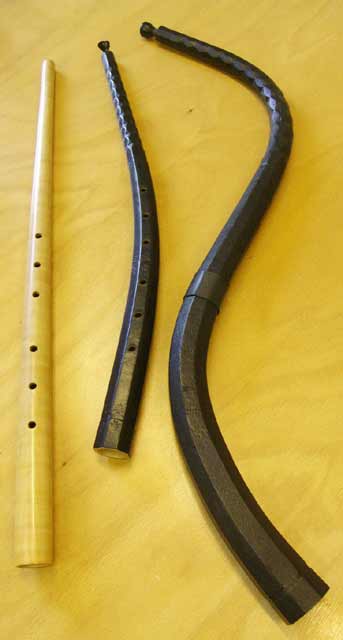
The cornett was made from a single block of wood, carved into an octagonal profile, and featured seven finger holes - six on top and one for thumb. It had a small mouthpiece, and the player made sound by vibrating his lips against this mouthpiece, not unlike on a trumpet, and covering the finger holes.
In its most popular time, between 1550-1650, it was the instrument most often used for virtuosic display, and there was a lot of solo repertoire composed for it. It's tone quality is often described as like that of the human voice, especially a boy soprano. It was used in alta capellas with several of the instruments looked at above, and also two cornett's was frequently used in consort with three sackbuts, often to double a church choir. By the late 17th century its popularity declined in favour of the string family of instruments.

No comments:
Post a Comment