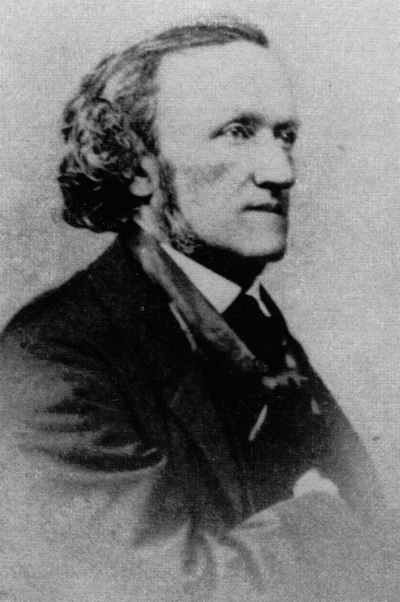
Wagner was a voluminous writer and published essays and pamphlets on a wide range of subjects throughout his life. 'Das Judenthum in der Musik' - Jewishness in Music was originally published under a pseudonym in 1850, with an expanded version released under Wagner's name in 1969. In a 1951 letter to Franz Liszt, Wagner's reasoning for using a pseudonym was 'to prevent the question being dragged down by the Jews to a purely personal level'. This essay is regarded by some as an important landmark in the history of German anti-semitism. It is clear from this any many of Wagner's other writings that he was anti-Semitic, but it's questionable that he was so to a greater degree to many other people of the times, whether famous or not.
Wagner is often touted as having a 'link' to Nazism. It is impossible to maintain this view when you take into account that Wagner died 50 years before Hitler assumed power, and six years before Hitler was even born. Hitler and his 'Juderein' police state, who's job it was to ethnically-cleanse an area of Jews, were not even on Wagner's radar. It cannot be argued however that Wagner wasn't a huge icon for Hitler. He wrote in his first volume of his book Mein Kampf: "At the age of twelve, I saw ... the first opera of my life, Lohengrin. In one instant I was addicted. My youthful enthusiasm for the Bayreuth Master knew no bounds." Hitler presented himself as an admirer of Wagner's music, and is said to have claimed that "there is only one legitimate predecessor to National Socialism: Wagner". Wagner's music was frequently played during Nazi rallies, as was the music of Beethoven, another heroic German figure who was 'appropriated' by the Nazis. Wagner's music often focused on archetypal Germanic heroes, so his strong nationalistic pride was probably the main magnetic pull for Hitler and Nazism.
Die Meistersinger von Nürnberg was a popular and prominent opera during 1871's unification of Germany, and in the coming years became a symbol of German patriotism. At the conclusion of Act 3, Hans Sachs issued a warning that German art needed protecting from 'foreign threats' and this was used as a rallying point for German nationalism during the Franco-Prussian war, the Wilhelmian Reich, the Weimar Republic, and most notoriously, during the Third Reich. The characters of Mime in the Ring, Sixtus Beckmesser in Die Meistersinger, and Klingsor in Parsifal are sometimes claimed as Jewish representations. There is no evidence of this in the libretto's however, and in my opinion the characters were later made to fit the racist ideology rather than the other way around.
I would have to say after my brief research that people who blame Wagner for the actions of the Nazi's are putting the cart before the horse. Hitler and the Nazi party took a huge German patriot and capitalising on his fame and generational opinion of the Jews, twisted his ideology to fit their own, making Wagner a showpiece and spokesperson for their own intense hatred and racism. With that being said, I can absolutely see why it would be difficult if not impossible for some people who were affected by the actions of Hitler and his Nazi party to listen to or accept Wagner's music once these skewed and 'hidden meanings' in his art had been posthumously applied, and to who it has has strong and tragic associations.
The arguments on this topic, and Wagner's terrible PR, continue to this day with occasional incidents that further ignite the issue. A recent example would be a new production of “Tannhäuser” in Düsseldorf, which featured violent scenes of shootings and gassings, and depictions of Nazi concentration camps which caused uproar in the audience.

No comments:
Post a Comment