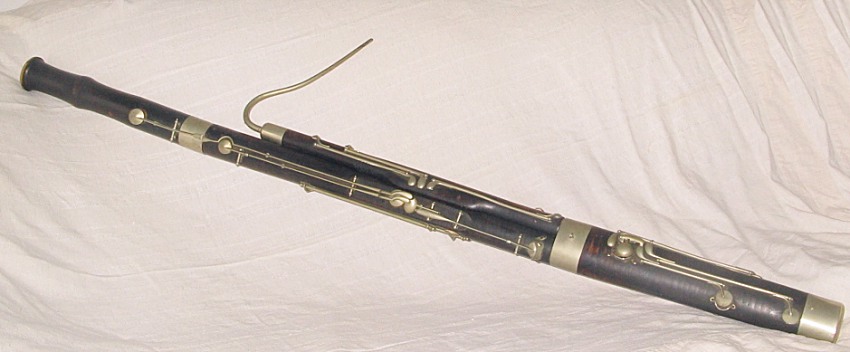
The general consensus among music historians is that the modern bassoon derives from the 'dulcian' from the renaissance period, as they both share some distinct characteristics, such as the unique shape of the bore, and the metal crook to which the double reed is attached.
Note Production
The bassoon uses a double reed like the oboe, however the shape of the instrument and its bocal (metal crook) alters the sound to produce its own unique flavour, rather than just a continuation of the oboe's bass register. As with all woodwinds, different notes are produced with the use of the keys. Due to its size, the instrument employs long levers and holes placed at an angle in the thick wood to make fingering possible. Like the other woodwinds, further pitch control can be obtained by changing embouchure, alternate fingerings, and the pushing in or pulling out of the bocal.
Due to the weight of the instrument, it is supported by either a strap when the player is standing, or a seat belt when the player is seated.
The oboe is the woodwind's answer to the cello, and trombone. It's dark, woody timbre is often said to be reminiscent of the male baritone voice.
Construction
The bassoon consists of six distinct parts - the reed, the bocal, the wing joint, the boot, the long joint, and the bell. The body is usually made of maple, while the metal parts are brass or nickel. Student models can also be made of plastic.
Playing Techniques
Despite it's large size, the bassoon is extremely agile. Large leaps, and rapid passages are possible, in all but the lowest end of the register.
The bassoon shares many playing techniques with the other woodwinds, such as:
- Single Tonguing
- Vibrato
- Flutter Tonguing
- Trills
- Tremolo
- Glissando
- Key Slap
- Slap Tongue
- Circular breathing to prolong sound for long periods of time

No comments:
Post a Comment